An EWS Certificate Bihar gets you the 10% reservation in government jobs, UPSC/SSC/state PSC exams, and college admissions reserved for economically weaker sections of the General category. To qualify, your family’s annual income needs to be under ₹8 lakh, along with a few land and property limits we’ll walk through below. You apply through serviceonline.bihar.gov.in — the same RTPS portal used for every other RTPS Bihar certificate.
Table of Contents
Quick Facts
| Detail | Info |
|---|---|
| EWS Full Form | Economically Weaker Section |
| Legal Basis | 103rd Constitutional Amendment, 2019 |
| Reservation Benefit | 10% in govt jobs, UPSC/SSC/PSC exams, college admissions |
| Issuing Department | Revenue Department (via RTPS) |
| Eligible Category | General category only |
| Income Limit | Below ₹8 lakh/year (family) |
| Validity | 1 financial year, renewal needed annually |
| Typical Processing Time | Around 15 working days |
📍 Get More Updates from Hind Yojna
Who’s Actually Eligible for an EWS Certificate Bihar
This is where most confusion happens, so let’s be precise about every condition — all of these need to be true together, not just the income one:
- Category: Only General (unreserved) category applicants qualify. If you’re already covered under SC, ST, or OBC reservation, you’re not eligible for EWS — the two don’t stack.
- Income: Your family’s total annual income, from every source and every member, needs to be under ₹8 lakh. That includes salary, business income, agriculture, rent, and interest — not just the applicant’s personal earning.
- Agricultural land: Your family shouldn’t own more than 5 acres.
- Residential plot: Under 100 square yards if it’s in a notified municipality area, or under 200 square yards outside municipality limits.
- Residential flat: Carpet area under 1,000 square feet.
All five conditions apply together — owning slightly more land than the limit, even with income well under ₹8 lakh, disqualifies you. Worth checking each one honestly before applying, since a false declaration on this specific certificate carries real legal consequences, not just rejection.
Documents Required for Applying an EWS Certificate
- Aadhaar Card: Mandatory identity proof for the applicant.
- Family Ration Card: (optional) to cross verify the number of dependent family members.
- Income Certificate: Issued by local revenue officer showing family income is below INR 8Lakh per year.
- Residential/Domicile Certificate: Proof that you are a permanent resident of Bihar
- Land/property documents (Khatian/LPC): to confirm you’re within the asset limits above.
- A recent passport-size photograph
- Self-Declaration/Affidavit: A signed form by applicant stating income and asset limits meet EWS criteria.
Scan these documents and save them in PDF/JPEG format so that they can be easily uploaded to the portal.
How to Apply for EWS Certificate Online
There are three levels of EWS Certificates that RTPS Bihar offers: Revenue Officer (RO)/Block Level, Sub-Divisional Officer (SDO) Level, and District Magistrate (DM) Level.
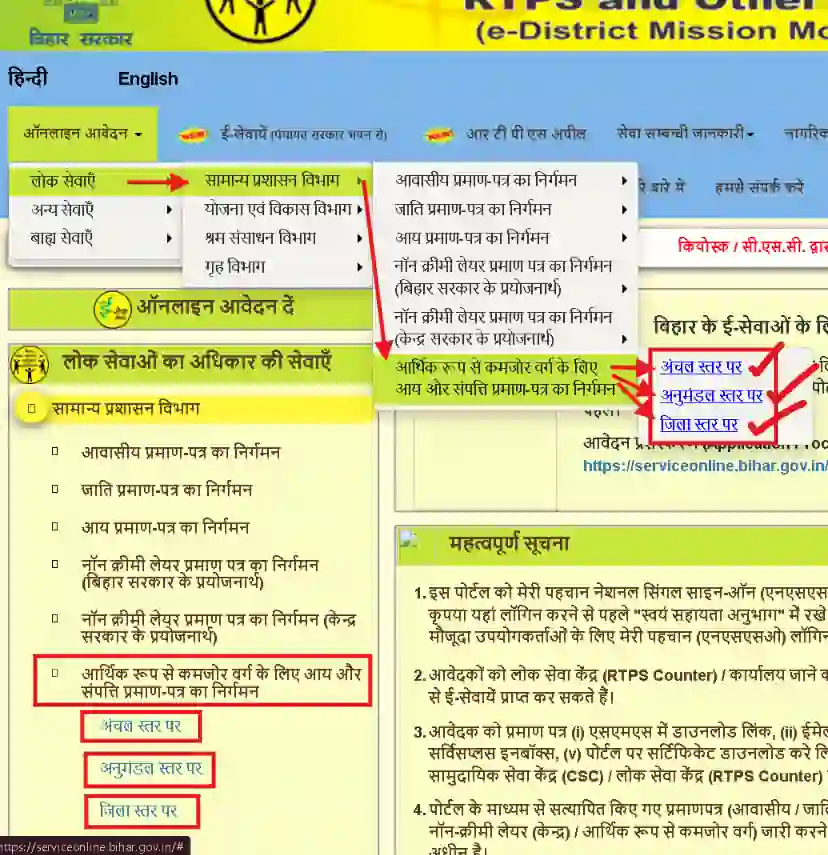
- Go to serviceonline.bihar.gov.in.
- Register with your mobile number if you’re a first-time user, and verify via OTP.
- Log in, then click “General Administrative Department” from the department list.
- Select “Issuance of Income & Asset Certificate for Economically Weaker Section.”
- Choose RO Level certificate 1st.
- Fill in your personal, income, and property details accurately — this is the form that gets cross-checked, so mismatches here are the most common reason for rejection.
- Upload the documents listed above.
- Submit — you’ll get an application/reference number. Save it; you’ll need it for both status tracking and downloading the finished certificate.
Note: To apply EWS Certificate at SDO level, you must have RO level certificate as you will be asked for Certificate No. issued from RO level and to apply EWS Certificate at DM Level you must have either RO level certificate or SDO level certificate as you will be asked for Certificate No. issued from RO/SDO level.
If you’d rather apply in person, the same form is available at your local RTPS counter or Common Service Centre (CSC) — useful if you’re not confident filling in fields correctly online, since staff there can help you get the numbers right the first time.
How to Check Your EWS Application Status
- Go to serviceonline.bihar.gov.in and select “Track Application Status.”
- Enter your application reference number.
- Your current stage — pending, under verification, or ready — shows immediately.
EWS applications specifically go through a verification stage where local revenue officials confirm your land and income declarations, which is part of why this one can take closer to 15 days rather than the faster turnaround on some other RTPS certificates.
How to Download Your EWS Certificate
- On serviceonline.bihar.gov.in,
- Select “Download Certificate.“
- Enter your application reference number and your name exactly as submitted.
- Complete the captcha and submit. Download the PDF once it loads, and keep both a digital and printed copy — most application processes (UPSC, SSC, college admissions) ask for the physical copy alongside the digital upload.
Validity & Renewal
An EWS Certificate is valid for one financial year from the date of issue. If you need it for an ongoing purpose — a multi-year scholarship, or reapplying to competitive exams across different years — you’ll need to reapply each year rather than assuming last year’s certificate still counts. For a one-time use like a single exam or admission cycle, the certificate issued that year is sufficient on its own.
Important Links (Official Only)
| Service | Direct Link |
|---|---|
| EWS Certificate — Revenue Officer (RO)/Block Level | Apply EWS Bihar RO Level |
| EWS Certificate — Sub-Divisional Officer (SDO) Level | Apply EWS Bihar SDO Level |
| EWS Certificate — District Magistrate (DM) Level | Apply EWS Bihar DM Level |
| Check Application Status | Check Application Status → Track Application |
| Download EWS Certificate | Download Certificate |
| Official Site | serviceonline.bihar.gov.in |
| RTPS Appeal (if delayed) | rtpsappeal.bihar.gov.in |
Frequently Asked Questions (FAQs)
Who is eligible for EWS in Bihar?
General category residents of Bihar with family income under ₹8 lakh/year, owning less than 5 acres of agricultural land, and within the specified residential plot/flat size limits.
Is EWS certificate valid for 3 years?
No — it’s valid for one financial year and needs to be renewed annually if you need it for ongoing use.
How much does an EWS certificate cost in Bihar?
It’s issued through the RTPS portal, which charges a small nominal application fee (typically free or under ₹50), consistent with other RTPS certificates.
What documents are needed for EWS certificate in Bihar?
Aadhaar Card, Family Ration Card, income proof for all family members, land/property documents, a passport photo, and residence proof.
What is the full form of EWS?
Economically Weaker Section.
Can SC, ST, or OBC candidates apply for EWS certificate?
No. EWS is exclusively for General category candidates who aren’t covered under any other reservation category.
How long does EWS certificate processing take in Bihar?
Typically around 15 working days, since it involves verification of your income and land declarations by local revenue officials.
Conclusion
The income limit gets most of the attention, but the land and property conditions disqualify just as many applicants — check all five eligibility points honestly before applying. Once you’re confident you qualify, the process itself runs through the same RTPS portal as every other Bihar certificate, and remember to renew each year if you need it ongoing rather than assuming one certificate covers you indefinitely.
Disclaimer: This guide is compiled from official Bihar government sources and verified public information for reader awareness. Hind Yojna is an independent platform and not affiliated with the Government of Bihar. Eligibility criteria and processes may change — always confirm current details on the official portal before applying.

The founder and author of Hind Yojna. He researches and writes easy-to-understand articles on Central and State Government schemes, public services, official documents, and citizen welfare programs. His focus is on providing accurate, up-to-date, and reliable information from official government sources to help readers access government services with confidence.